

CHC Logo

Celtic Hammer Club Blog

SHOP NOW!

Friday, November 1, 2019
Highlander Charge
“Highlander Charge” depicts an army of Celtic warriors charging into battle. The artwork is not meant to accurately depict any particular Celtic group or tribe. Rather, it’s a romanticized image taking bits and pieces from different elements of Celtic culture throughout history to make one composite representation of the Celtic warrior.


Legend of the White Stag
White stags have played a role in many mythologies and legends, especially in the North. The Celts believed them to be messengers from the otherworld. The white stag’s appearance would be an omen for whoever sighted it. The legends of King Arthur indicated that the white stag had a supernatural ability to avoid capture, and pursuit of the magical beast was akin to a spiritual quest.


Friday, September 13, 2019
Drink to the Gods
Offering ale, wine, or mead to the gods, the dead, or spirits has been a part of ritual and religion for millennia. It’s a practice that spreads across much of history and culture. It’s a powerful expression used to bring together communities in a reaffirmation of beliefs and values. My knotwork-style representation of this type of offering depicts two warriors hoisting their drinking horns to the sky!

 |
| "Drink to the Gods" Available for purchase on apparel and accessories. Click here! |

Wednesday, July 10, 2019
Vae Victis! - Woe to the Vanquished!
My latest design paying homage to the Iron Age Celts! Specifically, the Celtic Chieftain, Brennus, and his horde of Celtic warriors who sacked Rome in 390 B.C. Its the only time Rome was sacked before the fall of the Roman Empire many centuries later.
After taking Rome, the Celts demanded an exorbitant amount of gold be paid as ransom for the city. As the Romans begrudgingly weighed out the gold to ransom, some Romans began to complain to Brennus that the weights being used were faulty in the Celts favor.
Hearing these whining, Roman gripes, Brennus jumped to his feet, threw his sword on the scale and bellowed in a guttural voice, “Vae Victis!” Or, “Woe to the Vanquished!” In other words, “What are you gonna do about it?!” The sacking of Rome and subsequent humiliation in 390 B.C. by Brennus left a psychological scar that the Romans never forgot, and it is theorized that this collective mental scarring would influence Julius Ceasar and Rome’s obsessive desire to conquer Gaul centuries later when Rome grew to super power status.
My artwork here depicts an Iron Age Celtic shield and various Iron Age Celtic implements of war that have been discovered by archaeologists and have unique and distinctive appearances. VAE VICTIS!

After taking Rome, the Celts demanded an exorbitant amount of gold be paid as ransom for the city. As the Romans begrudgingly weighed out the gold to ransom, some Romans began to complain to Brennus that the weights being used were faulty in the Celts favor.
Hearing these whining, Roman gripes, Brennus jumped to his feet, threw his sword on the scale and bellowed in a guttural voice, “Vae Victis!” Or, “Woe to the Vanquished!” In other words, “What are you gonna do about it?!” The sacking of Rome and subsequent humiliation in 390 B.C. by Brennus left a psychological scar that the Romans never forgot, and it is theorized that this collective mental scarring would influence Julius Ceasar and Rome’s obsessive desire to conquer Gaul centuries later when Rome grew to super power status.
My artwork here depicts an Iron Age Celtic shield and various Iron Age Celtic implements of war that have been discovered by archaeologists and have unique and distinctive appearances. VAE VICTIS!

Friday, June 7, 2019
Yggdrasil Ragnarök
Yggdrasil, or “World Tree,” is a central feature of Norse mythology. The World Tree houses all nine of the mythological Norse realms, and several mythological creatures occupy its branches. My artwork here shows Thor, the thunder god, battling his nemesis the “World Serpent” Jörmungandr. Thor and the world serpent do battle in the cataclysmic Ragnarök where they kill each other in their final battle.


 |
| CLICK HERE FOR "YGGDRASIL RAGNARÖK" APPAREL AND ACCESSORIES |
Fighting Fenrir Series
I’ve created a mash up of my most popular designs to create something new! I’m calling this one “Fighting Fenrir.” Which color scheme is your favorite?
ALL of the color schemes you see pictured are currently available online! Go to CELTICHAMMERCLUB.COM to see all the cool stuff they are printed on!


ALL of the color schemes you see pictured are currently available online! Go to CELTICHAMMERCLUB.COM to see all the cool stuff they are printed on!


Tuesday, May 21, 2019
Celtic Warrior Series
Celtic warriors have been renowned for their prowess on the battlefield since ancient times. They were head hunters, displaying the heads of their slain victims in their homes as trophies, and they charged into battle adorned in blue war paint. This artwork pays homage to the Celtic warrior legacy.
 |
| SCOTLAND |
 |
| IRELAND |
 |
| WALES |
 |
| CELTIC WARRIOR |
Friday, March 15, 2019
The Binding of Fenrir
“The Binding of Fenrir” has become one of the most popular tales in Norse mythology. Fenrir is a large wolf, and the offspring of the god Loki. Fenrir lived with the gods in Asgard, but as Fenrir continued to grow and grow into a monstrously large size, the gods knew he posed too much of a threat to continue his residence in Asgard. So, the gods executed a plot to bind Fenrir and remove him from Asgard.
The gods bound Fenrir with various chains as a test of Fenrir’s strength. Each time, Fenrir answered the challenge and was able to break free of every chain presented to him. However, in secret, the gods sent a messenger to Svartalfheim, the home of the dwarves, master craftsmen who forged a magical binding which could not be broken. They named this magical chain Gleipnir.
When presented with the magical Gleipnir, Fenrir detected something was up, and requested one of the gods place their hand in his mouth as an assurance that this was no trick. Every god refused knowing full well that this would mean the loss of their hand to the mighty Fenrir. Only Tyr, bravest of the gods, was willing to offer his hand to Fenrir.
After being bound by Gleipnir and discovering that he was indeed trapped and unable to free himself, Fenrir took his revenge and bit off the hand of Tyr. The gods promptly hauled Fenrir away to a far away place where he remains until Ragnarok.
The symbolism of the brave Tyr sacrificing his hand to the powerful Fenrir is reflected in this artwork.

The gods bound Fenrir with various chains as a test of Fenrir’s strength. Each time, Fenrir answered the challenge and was able to break free of every chain presented to him. However, in secret, the gods sent a messenger to Svartalfheim, the home of the dwarves, master craftsmen who forged a magical binding which could not be broken. They named this magical chain Gleipnir.
When presented with the magical Gleipnir, Fenrir detected something was up, and requested one of the gods place their hand in his mouth as an assurance that this was no trick. Every god refused knowing full well that this would mean the loss of their hand to the mighty Fenrir. Only Tyr, bravest of the gods, was willing to offer his hand to Fenrir.
After being bound by Gleipnir and discovering that he was indeed trapped and unable to free himself, Fenrir took his revenge and bit off the hand of Tyr. The gods promptly hauled Fenrir away to a far away place where he remains until Ragnarok.
The symbolism of the brave Tyr sacrificing his hand to the powerful Fenrir is reflected in this artwork.

Wednesday, March 13, 2019
Ēostre
Ēostre was an ancient heathen goddess of the dawn. Her name is where we get the name “Easter” today. Ēostre (or Ostara in Old High German) represents the coming of the spring and the beginning of a new season of growth and fertility. Even though the old heathen customs were adopted into Christianity, the modern Easter is still flush with symbols of the old Easter. Easter bunnies, decorating eggs, tulips, and other spring time motifs are still very much with us today.


Thursday, February 28, 2019
Skál
Almost all cultures have special words or toasts to acknowledge the activity of bonding with others over drinks. The Celtic and Norse tribes were no exception. Fermented beverages played an important role in rituals and sacrifices. It brought people together to help create a sense of comradery and community. Mead and ale took on an almost supernatural power as they are often referenced in sagas and mythology. Mead was referred to as the “nectar of the gods.” Much of the Saxon epic poem Beowulf is set in a mead hall. So raise your drink, and toast to the long held traditions of the past. Skál! Sláinte! Cheers!


Thursday, January 24, 2019
Boar War Pig
The boar has played a prominent role in Celtic and Germanic culture since antiquity. This image was inspired by a well known Pictish carving stone dating to the 7th century. The Orkney Islands in Scotland take their name from Celtic word for boar. The boar was also used by the Vikings with the mythological Gullinbursti being the war pig of Norse god Freyr.

Thursday, December 6, 2018
Huginn & Muninn, Odin's Ravens
Huginn and Muninn (“Thought” and “Memory” respectively) are pet ravens of the Norse god, Odin. Odin’s ravens fly all over Midgard (Earth) collecting all of the information they can in order to report it back to Odin. In my interpretation, Huginn and Munnin are surrounding a magical stave named Ægishjálmr (Helm of Awe or Helm of Terror). It’s one of the most mysterious and powerful symbols in Norse mythology.


 |
| CLICK HERE TO SHOP THE "HUGINN & MUNINN" DESIGN |
Wednesday, August 29, 2018
Thor Odinson, God of Thunder
Thor, son of Odin, god of Thunder, protector of Midgard. Thor was a popular Norse god among the common farmers of Scandinavia and other Germanic speaking cultures as he was a protector of the people. Thor’s magical war hammer, Mjölnir, is the centerpiece of my artwork here. Mjölnir pendants were worn by many including the Vikings in the Middle Ages as a symbol of Thor’s protection and strength. Thor continues to be a popular figure in modern culture.

Thursday, August 16, 2018
Fenrir Viking Shield
This Viking shield design builds on my most popular artwork of the wolf Fenrir. Fenrir is an enormous, monster wolf from Norse mythology, and is the father of all wolves. You’ll see Fenrir painted on the circular Viking shield. The shield is accented with two heavy-duty Viking axes that are decorated with wolves and Viking-style knot work. The shield is also accented by knot work and Elder Futhark runes.


Full Color Version:

Grayscale Version:

Shop The Fenrir Viking Designs at CELTICHAMMERCLUB.COM

Tuesday, July 3, 2018
Odin the Wanderer
One of the personas of Odin is when he disguises himself and travels Midgard in search of knowledge and wisdom. As this persona, he is often portrayed as a wizard-like character. In fact, J.R.R. Tolkien used Odin the Wanderer as the foundation for the Gandalf the Wizard character in Lord of the Rings. This is my portrait of Odin as his Wanderer persona riding his horse, Sleipnir, who has eight legs in the mythology. Odin carries a magical spear named Gungnir.


Friday, May 11, 2018
Banshee (bean sí)
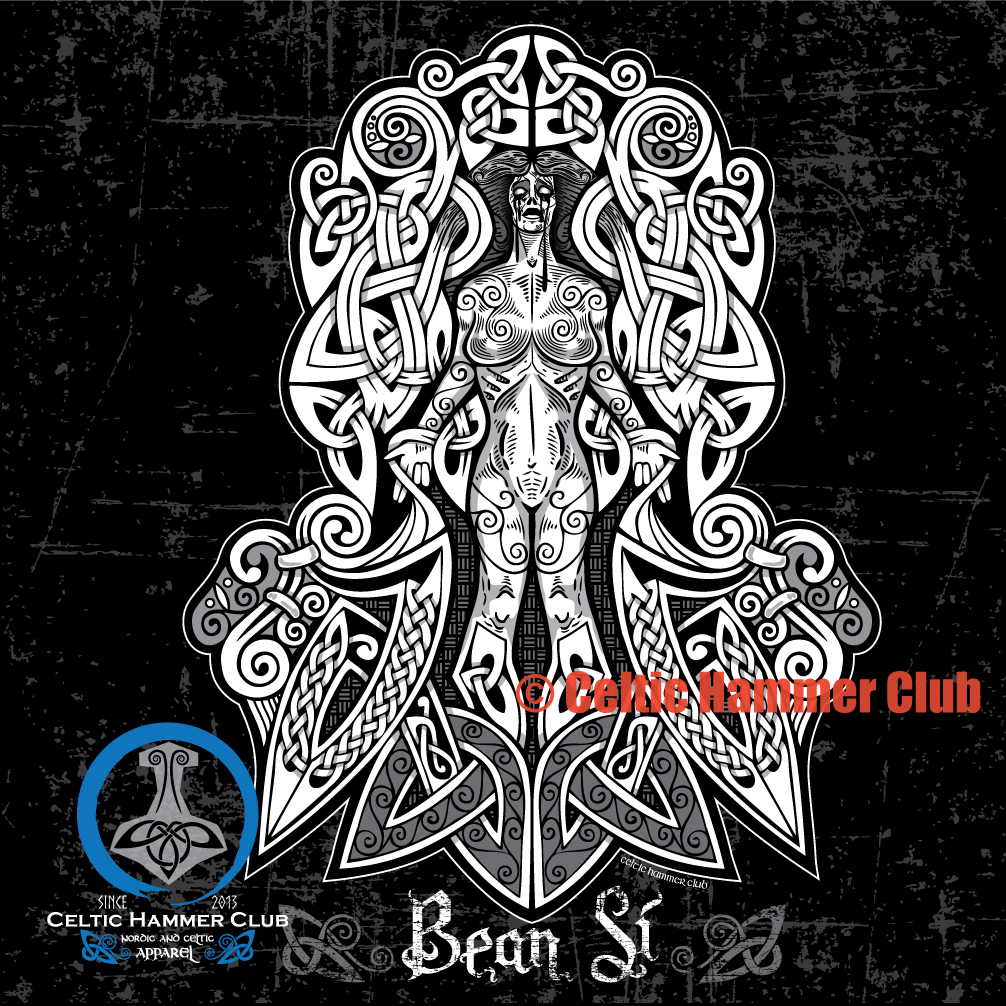
The banshee (bean sí in Irish) is a ghoulish figure from ancient Celtic fairy lore. She is said to appear as an omen of death, wailing and crying outside of the home for a loved one in the house who is soon to die. She is a pretty terrifying figure. Legend has it that the banshee only wails for five different Irish families. I am a descendant of one of those five families, so I felt compelled to portray this wailing wench in all her spooky glory!
I used the Celtic knots and spirals to represent both the banshee's hair and ghostly, whispy lower limbs. Her body is meant to look kind of androgynous. I'm a fan of engraving style artwork, so I used lots of lines on her body to create some depth, but they also look like they could be scars or tattoos of some kind. Basically, I tried to make her look creepy. Hopefully, I achieved that through mixing the engraving style into this.
I used the Celtic knots and spirals to represent both the banshee's hair and ghostly, whispy lower limbs. Her body is meant to look kind of androgynous. I'm a fan of engraving style artwork, so I used lots of lines on her body to create some depth, but they also look like they could be scars or tattoos of some kind. Basically, I tried to make her look creepy. Hopefully, I achieved that through mixing the engraving style into this.
 |
| Initial sketch |
 |
| Sketch continued |
 |
| Final product! |
Tuesday, April 17, 2018
Robin Hood
This is my take on the legendary Robin Hood! The Prince of Thieves done up in a Neo-Celtic style! I like the image of Robin as a Native Briton (either Saxon or Celtic) fighting the invading Normans. I used the leaves on him not just to represent camouflage in the forest, but also to draw connections to the Greenman whose archetype has often been associated with Robin.


 |
| Full Color Version |
 |
| Green Copper Version |


 |
| Women's Racerback Tank |


Friday, February 23, 2018
Celtic Elk Rampant
I did this bull elk in what could be called a Neo-Celtic or Neo-Nordic style. The stippling and knots are more traditional, but the image has a modern edginess to it. Elk and other antlered species have been a popular archetype representing strength, power, and virility going back to ancient times.


Wednesday, January 31, 2018
Don't Get My Irish Up!
 |
| MEN'S TEE (WOMEN'S STYLES AND MORE AVAILABLE) |
The Irish immigrants made quite the impression when they landed on American shores. Their penchant for fighting and rowdiness has been immortalized with ideas of the "fighting Irish," the "Irish temper," and another famous phrase which has become mainstream. "Don't Get My Irish Up" means "don't provoke me, or my Irish temper will come out, and you'll know why we are known as the 'fighting Irish'!"
 |
| MEN'S TEE (WOMEN'S STYLES AND MORE AVAILABLE) |


Wednesday, December 20, 2017
Yule Elf Viking Godmask
Most of our Christmas traditions have their roots in Viking culture where the time of year for decorated trees and garland was knows as Yule or Jol. Even Santa’s elves have their history in the folklore of the Vikings where elves and dwarves played a prominent role. This Yule Elf is done in a Viking artwork style and is what is called a “godmask.” Celebrate the Yule season Viking style!
 |
| Black and Gray Yule Elf Tee |
 |
| Red and Green Yule Elf Tee |
Subscribe to:
Posts (Atom)