CHC Logo

Celtic Hammer Club Blog

SHOP NOW!

MY DESIGNS ARE OFFICIALLY AVAILABLE ON THESE SITES:
Showing posts with label Celt. Show all posts

Friday, March 15, 2019

The Binding of Fenrir

“The Binding of Fenrir” has become one of the most popular tales in Norse mythology. Fenrir is a large wolf, and the offspring of the god Loki. Fenrir lived with the gods in Asgard, but as Fenrir continued to grow and grow into a monstrously large size, the gods knew he posed too much of a threat to continue his residence in Asgard. So, the gods executed a plot to bind Fenrir and remove him from Asgard.

The gods bound Fenrir with various chains as a test of Fenrir’s strength. Each time, Fenrir answered the challenge and was able to break free of every chain presented to him. However, in secret, the gods sent a messenger to Svartalfheim, the home of the dwarves, master craftsmen who forged a magical binding which could not be broken. They named this magical chain Gleipnir.

When presented with the magical Gleipnir, Fenrir detected something was up, and requested one of the gods place their hand in his mouth as an assurance that this was no trick. Every god refused knowing full well that this would mean the loss of their hand to the mighty Fenrir. Only Tyr, bravest of the gods, was willing to offer his hand to Fenrir.
After being bound by Gleipnir and discovering that he was indeed trapped and unable to free himself, Fenrir took his revenge and bit off the hand of Tyr. The gods promptly hauled Fenrir away to a far away place where he remains until Ragnarok.

The symbolism of the brave Tyr sacrificing his hand to the powerful Fenrir is reflected in this artwork.


Wednesday, March 13, 2019

Ēostre

Ēostre was an ancient heathen goddess of the dawn. Her name is where we get the name “Easter” today. Ēostre (or Ostara in Old High German) represents the coming of the spring and the beginning of a new season of growth and fertility. Even though the old heathen customs were adopted into Christianity, the modern Easter is still flush with symbols of the old Easter. Easter bunnies, decorating eggs, tulips, and other spring time motifs are still very much with us today.

Thursday, February 28, 2019

Skál

Almost all cultures have special words or toasts to acknowledge the activity of bonding with others over drinks. The Celtic and Norse tribes were no exception. Fermented beverages played an important role in rituals and sacrifices. It brought people together to help create a sense of comradery and community. Mead and ale took on an almost supernatural power as they are often referenced in sagas and mythology. Mead was referred to as the “nectar of the gods.” Much of the Saxon epic poem Beowulf is set in a mead hall. So raise your drink, and toast to the long held traditions of the past. Skál! Sláinte! Cheers!


Thursday, January 24, 2019

Boar War Pig

The boar has played a prominent role in Celtic and Germanic culture since antiquity. This image was inspired by a well known Pictish carving stone dating to the 7th century. The Orkney Islands in Scotland take their name from Celtic word for boar. The boar was also used by the Vikings with the mythological Gullinbursti being the war pig of Norse god Freyr.


Thursday, December 6, 2018

Huginn & Muninn, Odin's Ravens

Huginn and Muninn (“Thought” and “Memory” respectively) are pet ravens of the Norse god, Odin. Odin’s ravens fly all over Midgard (Earth) collecting all of the information they can in order to report it back to Odin. In my interpretation, Huginn and Munnin are surrounding a magical stave named Ægishjálmr (Helm of Awe or Helm of Terror). It’s one of the most mysterious and powerful symbols in Norse mythology.


CLICK HERE TO SHOP THE "HUGINN & MUNINN" DESIGN

Wednesday, August 29, 2018

Thor Odinson, God of Thunder

Thor, son of Odin, god of Thunder, protector of Midgard. Thor was a popular Norse god among the common farmers of Scandinavia and other Germanic speaking cultures as he was a protector of the people. Thor’s magical war hammer, Mjölnir, is the centerpiece of my artwork here. Mjölnir pendants were worn by many including the Vikings in the Middle Ages as a symbol of Thor’s protection and strength. Thor continues to be a popular figure in modern culture.


Thursday, August 16, 2018

Fenrir Viking Shield

This Viking shield design builds on my most popular artwork of the wolf Fenrir. Fenrir is an enormous, monster wolf from Norse mythology, and is the father of all wolves. You’ll see Fenrir painted on the circular Viking shield. The shield is accented with two heavy-duty Viking axes that are decorated with wolves and Viking-style knot work. The shield is also accented by knot work and Elder Futhark runes.

Full Color Version:

Grayscale Version:


Shop The Fenrir Viking Designs at CELTICHAMMERCLUB.COM


Friday, May 11, 2018

Banshee (bean sí)

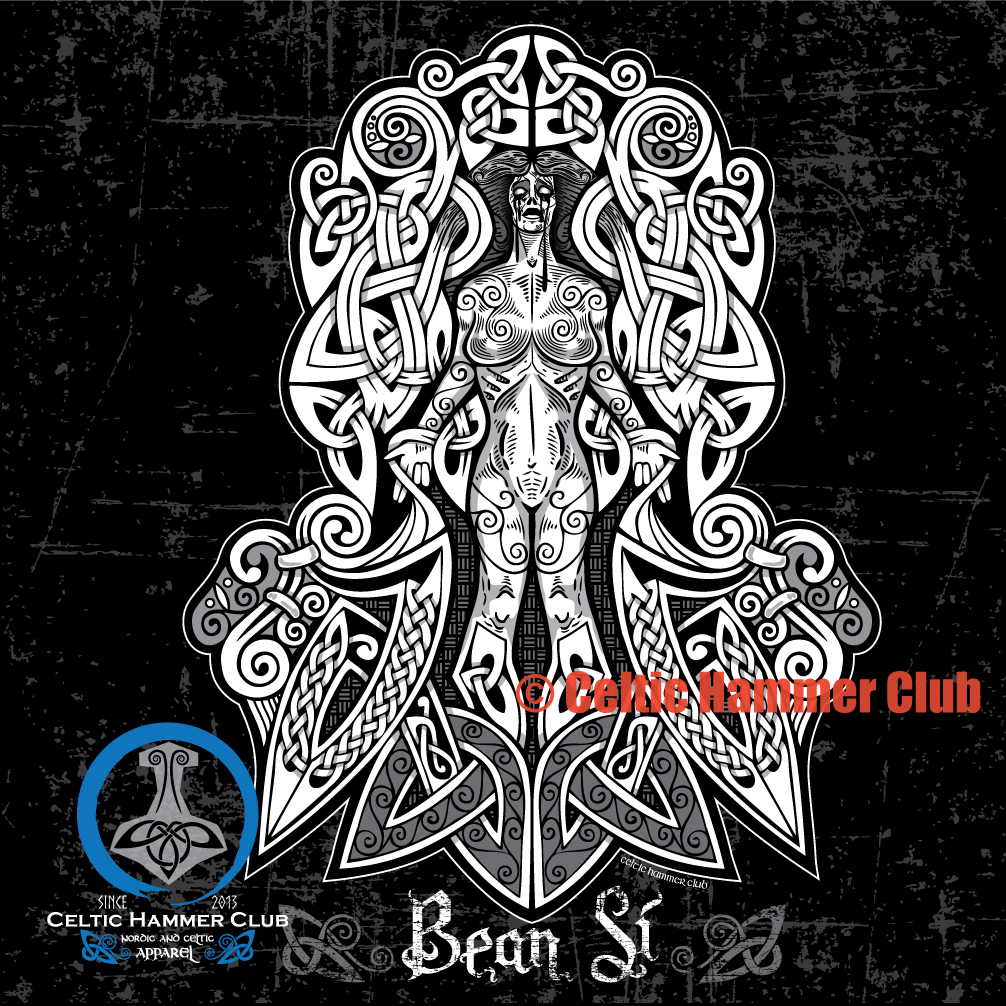
The banshee (bean sí in Irish) is a ghoulish figure from ancient Celtic fairy lore. She is said to appear as an omen of death, wailing and crying outside of the home for a loved one in the house who is soon to die. She is a pretty terrifying figure. Legend has it that the banshee only wails for five different Irish families. I am a descendant of one of those five families, so I felt compelled to portray this wailing wench in all her spooky glory!

I used the Celtic knots and spirals to represent both the banshee's hair and ghostly, whispy lower limbs. Her body is meant to look kind of androgynous. I'm a fan of engraving style artwork, so I used lots of lines on her body to create some depth, but they also look like they could be scars or tattoos of some kind. Basically, I tried to make her look creepy. Hopefully, I achieved that through mixing the engraving style into this.

Initial sketch


Sketch continued

Tuesday, April 17, 2018

Robin Hood

This is my take on the legendary Robin Hood! The Prince of Thieves done up in a Neo-Celtic style!  I like the image of Robin as a Native Briton (either Saxon or Celtic) fighting the invading Normans.  I used the leaves on him not just to represent camouflage in the forest, but also to draw connections to the Greenman whose archetype has often been associated with Robin.


Full Color Version
Green Copper Version

Women's Racerback Tank


Friday, February 23, 2018

Celtic Elk Rampant

I did this bull elk in what could be called a Neo-Celtic or Neo-Nordic style. The stippling and knots are more traditional, but the image has a modern edginess to it. Elk and other antlered species have been a popular archetype representing strength, power, and virility going back to ancient times.


Wednesday, September 6, 2017

Dragon Slayer


The "Dragon Slayer" design is in a Norse style depicting a dragon with a sword running through it. The runes on the dragon's body spell out "DRAGON SLAYER."

Gold Dragon available here.


Thursday, August 17, 2017

Celtic Harvest Reaper


It’s the busiest time of the year, HARVEST! The days are slowly getting shorter. The smell in the air starts to change. It’s becoming cooler at night. Summer is winding down. The Oak King is aging, and the Holly King is becoming stronger. The Holly king is waiting patiently for his strength to return so that he may challenge the Oak King on Samhain (Halloween), and DEFEAT him, thereby ushering in winter.

So you must stay busy. Harvest your crops and store them in preparation for the winter ahead. There’s still time. Hard work during the Harvest will be rewarded.


Friday, July 14, 2017

Fenrir: Ragnarok Viking Monster Wolf

Fenrir: Ragnarok Viking Monster Wolf
Fenrir (or Fenris) is a gigantic, monster wolf of Norse Viking folklore. Fenrir is a child of the Norse god Loki, and is responsible for gobbling up the god Odin WHOLE during the events of Ragnarok. Fenrir is so ferocious that only a magical chain forged by the dwarves can bind him. The god Tyr (represented by the rune that looks like an arrow in this image) had his right hand bitten off by Fenrir. This image shows Fenrir breaking free of the magical dwarven chains that bind him.

Fenrir Men's Tee. Much more apparel and accessories available in the online store!
This is my original sketch of this design.

Monday, July 10, 2017

Cú Chulainn: The Irish Berserker

Cú Chulainn is one of the most famous of all Celtic Irish mythological heroes. He rose to fame from his exceptional skills at the Irish sport of Hurling. He then solidified his legend by killing the monstrous hound of Culann. Cú Chulainn is most famous for his great berserker rage in battle; turning himself into a giant rage monster that would slaughter men by the hundreds!


Black and White Version
Color Version


My vision for my Cú Chulainn portrait was to try to sum up all the different components to his mythology in a single image. So Cú Chulainn himself is at the center carrying a hurley which he used to slay Culann's hound, and, thereby, earning the name Cú Chulainn which is Irish for Culann's hound (Cú Chulainn agreed to replace Culann's guard hound after killing it.) He is also carrying the magical barbed spear named Gáe Bulg.

Wednesday, May 31, 2017

The Morrigan: Irish War Goddess


INITIAL SKETCH OF "THE MORRIGAN"

The Morrigan plays a prominent role in Irish mythology. She is associated with war, and is a shape-shifter, often taking the form of a battle crow. In the form of the battle crow, she is said to control fate; predicting which warriors shall live or die. In this capacity, she is quite similar to the Norse Valkyries. 

Friday, December 23, 2016

"MJÖLNIR MEAD"


CLOSE UP VIEW OF THE "MJÖLNIR MEAD" DESIGN

Mjölnir, the mightiest of all mythological weapons. The war hammer of the god of thunder, Thor! The powerful symbol of the strongest of war implements has been worn by warriors and those looking for strength and protection for centuries.

Thursday, December 8, 2016

"Forging Mjölnir, Thor's Mighty Weapon"

Most are familiar with Thor, god of thunder, and his war hammer, Mjölnir, but from whence did this mighty, magical mallet materialize?


Mjölnir was forged by two bristly dwarf brothers who lived deep in the caverns of the dwarf homeland, Svartalfheim.


The dwarf brothers, Sindri and Brokkr, were exceptional metal workers, and they are responsible for the creation of several magical items throughout Norse mythology. Unfortunately for the brothers, the notorious trickster god, Loki, paid them a visit and taunted the poor brothers. They were going about their dwarf lives not bothering anyone, and Loki decides to start talking trash about how they can’t make stuff as good as the other dwarves , and the stuff they do make is crap, and on and on. Loki even went so far as to bet his own head on the fact that the brothers could not manufacture a single piece worth a jotun’s dung!

Monday, April 11, 2016

New Celtic Cross Designs!

This Celtic Cross design looks as though it was carved from stone! Click for a closer look.


The Celtic Cross is one of the most popular and enduring symbols of Celtic identity and culture. In the Dark Ages, as the Celtic populations of Britain and Ireland were converted to Christianity, they brought some of their older, pre-Christian  style to the symbols of Christianity. What was born was the Celtic Cross. A unique blend of the Old Celtic religion and the new Christian religion.

Friday, April 8, 2016

'Grunge' Celtic Cross


"GRUNGE" CELTIC CROSS


   The Celtic Cross is one of the most recognizable symbols of Celtic culture. In this design, the Dark Ages meet the Modern Age by combining the Celtic cross with some stylish "grunge" effects. Splatters and smears create a stylish weathered look to the Celtic Cross.

Thursday, March 31, 2016

Keltic Krampus II

"Keltic" Style Krampus

Ah, Christmas. Mother in her kerchief, and Father in his cap. The children swimming through a sea of wrapped gifts. Stockings stuffed with chocolate hang neatly above a blessed Yule log crackling away in the fireplace. So cozy. So joyous. The fear of possibly receiving coal in your stocking is long gone. The biggest fear children have around Christmas time these days is "Elf on a Shelf", and, boy, is he an intimidating figure....